


Positive Results: Kalgoorlie Drilling Programme
By LSE RNS
Date: Monday 19 Jan 2026

19 January 2026
Oracle Power PLC
("Oracle" or the "Company")
Further Positive Results from Kalgoorlie Drilling Programme
Oracle Power PLC (AIM:ORCP), an international project developer, is pleased to announce assay results from a further 21 drillholes at the Northern Zone Intrusive Hosted Gold Project, located within the Company's Kalgoorlie Gold Project (refer to Figure 1 for location). The values from selected drill holes are given in Tables 1-3 and in Figure 2. Results from a further 16 drillholes are anticipated to be received shortly.
Highlights
· The drilling programme has continued to intersect shallow gold mineralisation as drilling expands the gold footprint at the Northern Zone Gold Project.
· First assay results now arriving for 2026, with significant results, including:
· 8m @ 5.81 g/t Au from 46m (NZAC179)
· 7m @ 3.48 g/t Au from 48m (NZAC181)
· 5m @ 3.13 g/t Au from 41m (NZAC170)
· 4m @ 2.28 g/t Au from 43m (NZAC182)
· Further significant results shown in tables below
· Drilling results from a further 16 drillholes due to be received in two batches over the coming weeks.
· Drill rig booked for 10 February aiming to continue expanding the oxide gold mineralisation footprint.
· Conversion to Mining Lease process continues with the Heritage Agreement a major step forward.[1]
· The Mine Development and Closure Plan (MDCP) and the associated environmental assessments have commenced with Resource WA.
Naheed Memon, CEO of Oracle, commented:
"It is great to follow on from previous announcements and continue to expand and intersect gold grades in the northeast area and expand the saddle area. We believe these results are very impressive and add significant upside to the project for our plans with our partners for gold production targeted for later this year. Our modelling suggests that this could constitute part of a ~600m wide zone of shallow oxide mineralisation overlying the Northern Zone porphyry system.
"Oracle also notes from Riversgold's news release on the ASX today that MEGA Resources has become a shareholder of Riversgold, and we see this as highly promising for the JV partnership going forward.
"We are still awaiting results from 16 drillholes, expected in the coming weeks, and we are looking forward to the assays that will be from the northeast and saddle areas.
"The two recently completed drill programmes were designed to add to our gold footprint in the top 50-60m at our Kalgoorlie Gold Project, and to enhance the MEGA Resources mining scenario for 2026[2]. Results continue to expand the lateral footprint of Northern Zone and we are achieving the goal of making the project bigger in the oxide zone. I look forward to updating shareholders as we progress the project."
The latest drill programme results (Tables 1-3) continue to successfully intersect the mineralised host porphyry over an increasing footprint and consistently validate the broader gold mineralisation model. Gold mineralisation has been successfully intersected in the northeast area, with a section of drill holes to the north of an existing single line, expanding the gold mineralisation footprint (Figure 2). More drill results from the saddle area between the west and east zones is filling in nicely, with a further 12 holes due shortly. A key SW-NE cross-section derived from 3D Leapfrog software is illustrated in Figure 3. The interpretation illustrates gold grade shells derived from all the significant intercepts reported by Riversgold to April 2025. The Leapfrog model will be updated once all pending assays are received.
Northern Zone is hosted within a porphyry unit (Tonalite- Trondhjemite Intrusion, TTI), with high background gold and horizontal gold mineralised units within the TTI unit. The Northern Zone Project sits within the Canon Shear or fault zone, with further drilling required to define the limits of mineralisation identified to date. The horizontal mineralisation makes drilling to date perpendicular to the gold mineralisation, and no water in drilling to a depth of 60 metres makes the TTI also suitable for drilling with the techniques the Company has utilised to date.
Riversgold will continue advancing its understanding of the Kalgoorlie Project before proceeding with a maiden Mineral Resource Estimate (MRE), but this drilling will be used by Mega Resources in their mine planning for our joint plans to start mining in the first half of 2026.
For further information on Oracle, visit the Company's website at http://www.oraclepower.co.uk or contact:
Oracle Power PLC
Naheed Memon - CEO +44 (0) 203 580 4314
Strand Hanson Limited (Nominated Adviser & Broker)
Rory Murphy, Matthew Chandler, Rob Patrick +44 (0) 20 7409 3494
St Brides Partners Limited (Financial PR)
Susie Geliher, Will Turner +44 (0) 20 7236 1177
This announcement contains inside information for the purposes of Article 7 of EU Regulation No. 596/2014, which forms part of United Kingdom domestic law by virtue of the European Union (Withdrawal) Act 2018, as amended by virtue of the Market Abuse (Amendment) (EU Exit) Regulations 2019.
Competent Person's Statement
The information in this announcement that relates to exploration results, exploration targets, mineral resources or ore reserves is based on information compiled by Mr Edward Mead, who is a Fellow of the Australasian Institute of Mining and Metallurgy. Mr Mead is a director of Riversgold Limited and a consultant to the Company through Doraleda Pty Ltd. Mr Mead has sufficient experience which is relevant to the style of mineralisation and type of deposit under consideration and to the activity that he is undertaking to qualify as a Competent Person as defined in the 2012 edition of the `Australasian Code for Reporting Exploration Results, Mineral Resources and Ore Reserves' (the JORC Code). Mr Mead consents to the inclusion of this information in the form and context in which it appears in this announcement.
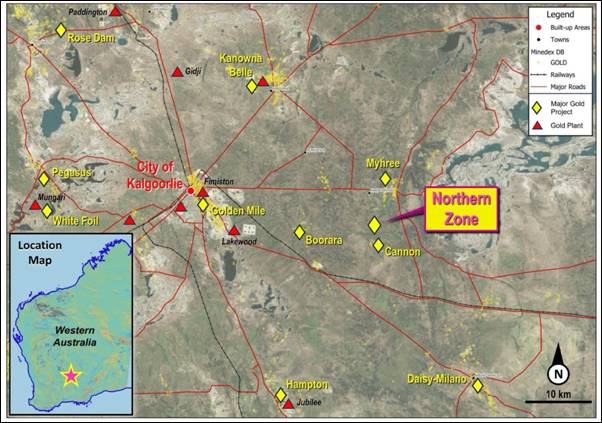
Figure 1: Location of Northern Zone Gold Project in relation to the Kalgoorlie Golden Mile/Fimiston "Super Pit".
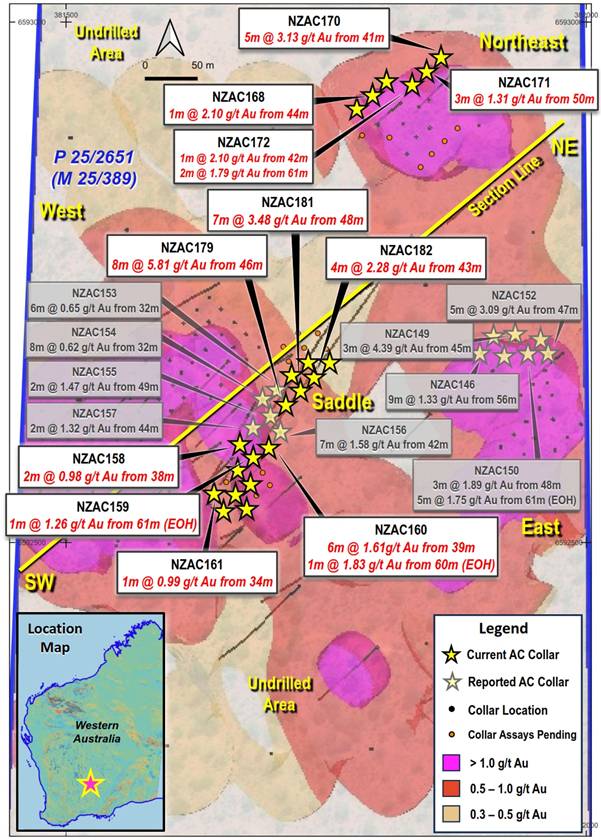
Figure 2: Drill collar plan and reported significant drill intercepts. Gold grade contours from all drilling results up to April 2025. Contours will be updated when all pending assays are received.
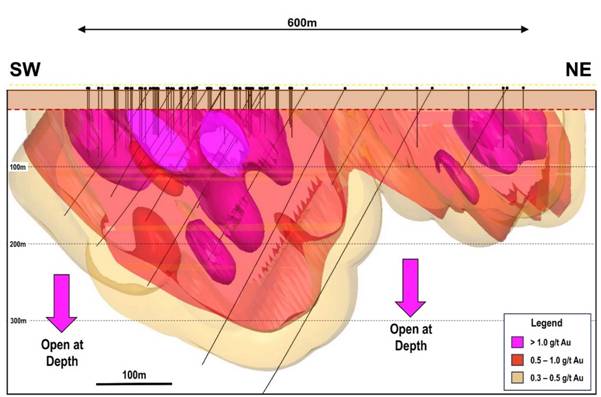
Figure 3: Cross-section of 3D Leapfrog software model. The interpretation illustrates gold grade shells, derived from all the significant intercepts reported to the ASX to April 2025. The Leapfrog model will be updated once all pending assays are received. The model is constrained via a 25m buffer to all the RGL/Oracle drill hole traces that have been drilled at Northern Zone since 2021. Refer to Figure 2 Drill collar plan for the location of the section line.
APPENDIX 1: Drilling Information
Table 1: Northern Zone Significant Intercepts from all grade control drill rig drillholes with previously reported results in grey.
Hole ID | From (m) | To (m) | Width (m) | Au g/t | Intercept | |
NZAC146 | 56 | 65 | 9 | 1.33 | 9m @ 1.33 g/t Au from 56m , NZAC146 | |
NZAC149 | 45 | 48 | 3 | 4.39 | 3m @ 4.39 g/t Au from 45m , NZAC149 | |
including | 47 | 48 | 1 | 0.93 | Including 1m @ 11.78 g/t Au from 47m , NZAC149 | |
NZAC150 | 48 | 51 | 3 | 1.89 | 3m @ 1.89 g/t Au from 48m , NZAC150 | |
NZAC150 | 61 | 66 | 5 | 1.75 | 5m @ 1.75 g/t Au from 61m (EOH) , NZAC150 | |
including | 64 | 66 | 2 | 3.49 | Including 2m @ 3.49 g/t Au from 64m (EOH) , NZAC150 | |
NZAC151 | 47 | 51 | 4 | 0.83 | 4m @ 0.83 g/t Au from 47m , NZAC151 | |
NZAC152 | 47 | 52 | 5 | 3.09 | 5m @ 3.09 g/t Au from 47m, NZAC152 | |
NZAC152 | 66 | 72 | 6 | 0.72 | 6m @ 0.72 g/t Au from 66m (EOH), NZAC152 | |
NZAC153 | 32 | 38 | 6 | 0.65 | 6m @ 0.65 g/t Au from 32m, NZAC153 | |
NZAC153 | 46 | 47 | 1 | 11 | 1m @ 11.0 g/t Au from 46m, NZAC153 | |
NZAC153 | 54 | 56 | 2 | 0.74 | 2m @ 0.74 g/t Au from 54m, NZAC153 | |
NZAC154 | 62 | 70 | 8 | 0.62 | 8m @ 0.62 g/t Au from 32m, NZAC154 | |
NZAC154 | 45 | 46 | 1 | 1.1 | 1m @ 1.10 g/t Au from 45m, NZAC154 | |
NZAC155 | 49 | 51 | 2 | 1.47 | 2m @ 1.47 g/t Au from 49m, NZAC155 | |
NZAC156 | 42 | 49 | 7 | 1.58 | 7m @ 1.58 g/t Au from 42m, NZAC156 | |
NZAC157 | 33 | 36 | 3 | 0.7 | 3m @ 0.70 g/t Au from 33m, NZAC157 | |
NZAC157 | 44 | 46 | 2 | 1.32 | 2m @ 1.32 g/t Au from 44m, NZAC157 | |
NZAC158 | 38 | 40 | 2 | 0.98 | 2m @ 0.98 g/t Au from 38m, NZAC158 | |
NZAC159 | 39 | 40 | 1 | 1.01 | 1m @ 1.01 g/t Au from 39m, NZAC159 | |
NZAC159 | 61 | 62 | 1 | 1.26 | 1m @ 1.26 g/t Au from 61m, NZAC159 (EOH) | |
NZAC160 | 39 | 45 | 6 | 1.61 | 6m @ 1.61 g/t Au from 39m, NZAC160 | |
NZAC160 | 60 | 61 | 1 | 1.83 | 1m @ 1.83 g/t Au from 60m, NZAC160 (EOH) | |
NZAC161 | 34 | 35 | 1 | 0.99 | 1m @ 0.99g/t Au from 34m, NZAC161 | |
NZAC162-167 No significant Intercept | ||||||
NZAC168 | 44 | 45 | 1 | 2.10 | 1m @ 2.10 g/t Au from 44m, NZAC168 | |
NZAC170 | 41 | 46 | 5 | 3.13 | 5m @ 3.13 g/t Au from 41m, NZAC170 | |
NZAC170 | 77 | 78 | 1 | 2.94 | 1m @ 2.94 g/t Au from 77m, NZAC170 | |
NZAC170 | 94 | 95 | 1 | 1.96 | 1m @ 1.96 g/t Au from 94m, NZAC170 | |
NZAC171 | 50 | 53 | 3 | 1.31 | 3m @ 1.31 g/t Au from 50m, NZAC171 | |
NZAC172 | 36 | 38 | 2 | 0.97 | 2m @ 0.97 g/t Au from 36m, NZAC172 | |
NZAC172 | 42 | 43 | 1 | 2.10 | 1m @ 2.10 g/t Au from 42m, NZAC172 | |
NZAC172 | 61 | 63 | 2 | 1.79 | 2m @ 1.79 g/t Au from 61m, NZAC172 | |
NZAC179 | 46 | 54 | 8 | 5.81 | 8m @ 5.81 g/t Au from 46m, NZAC179 | |
NZAC180 | No significant Intercept | |||||
NZAC181 | 48 | 55 | 7 | 3.48 | 7m @ 3.48 g/t Au from 48m, NZAC181 | |
NZAC182 | 43 | 47 | 4 | 2.28 | 4m @ 2.28 g/t Au from 43m, NZAC182 | |
NZAC183 | No significant Intercept | |||||
NZAC184 | No significant Intercept | |||||
Table 2: Northern Zone Drill Collar Locations with previously reported results in grey.
Hole ID | Type | MGA_E | MGA_N | Elevation (m) | Total Depth (m) | Dip () | AZM_MGA | Date |
NZAC146 | GC | 381899.8 | 6592682.5 | 356.7 | 66 | 0 | -90 | 20/10/25 |
NZAC147 | GC | 381912.2 | 6592694.9 | 356.8 | 63 | 0 | -90 | 21/10/25 |
NZAC148 | GC | 381919.8 | 6592682.5 | 356.7 | 66 | 0 | -90 | 22/10/25 |
NZAC149 | GC | 381932.2 | 6592 694.9 | 356.8 | 60 | 0 | -90 | 22/10/25 |
NZAC150 | GC | 381939.8 | 6592682.5 | 356.8 | 66 | 0 | -90 | 23/10/25 |
NZAC151 | GC | 381952.2 | 6592694.9 | 356.7 | 66 | 0 | -90 | 23/10/25 |
NZAC152 | GC | 381959.8 | 6592682.5 | 356.7 | 72 | 0 | -90 | 24/10/2025 |
NZAC153 | GC | 381702.7 | 6592645.4 | 356.4 | 66 | 0 | -90 | 25/10/2025 |
NZAC154 | GC | 381690.3 | 6592633 | 356.4 | 64 | 0 | -90 | 25/10/2025 |
NZAC155 | GC | 381698 | 6592620.6 | 356.3 | 60 | 0 | -90 | 25/10/2025 |
NZAC156 | GC | 381705.6 | 6592608.2 | 356.2 | 63 | 0 | -90 | 26/10/2025 |
NZAC157 | GC | 381681 | 6592608.2 | 356.3 | 62 | 0 | -90 | 26/10/2025 |
NZAC158 | GC | 381673.2 | 6592595.9 | 356.3 | 61 | 0 | -90 | 27/10/2025 |
NZAC159 | GC | 381680.8 | 6592583.5 | 356.2 | 62 | 0 | -90 | 28/10/2025 |
NZAC160 | GC | 381695 | 6592592 | 356.2 | 61 | 0 | -90 | 29/10/2025 |
NZAC161 | GC | 381643.7 | 6592546.4 | 356.2 | 65 | 0 | -90 | 30/10/2025 |
NZAC162 | GC | 381651.3 | 6592534 | 356.2 | 69 | 0 | -90 | 30/10/2025 |
NZAC163 | GC | 381663.7 | 6592546.4 | 356.1 | 68 | 0 | -90 | 31/10/2025 |
NZAC164 | GC | 381671.3 | 6592534 | 356.1 | 63 | 0 | -90 | 31/10/2025 |
NZAC165 | GC | 381676.1 | 6592558.7 | 356.1 | 66 | 0 | -90 | 1/11/2025 |
NZAC166 | GC | 381668.5 | 6592569 | 356.1 | 62 | 0 | -90 | 1/11/2025 |
NZAC167 | AC | 381782.8 | 6592917.7 | 357.2 | 38 | 0 | -90 | 17/11/2025 |
NZAC168 | AC | 381795.1 | 6592929.9 | 356.8 | 63 | 0 | -90 | 17/11/2025 |
NZAC169 | AC | 381807.6 | 6592942.4 | 356.5 | 75 | 0 | -90 | 18/11/2025 |
NZAC170 | AC | 381858.8 | 6592965.4 | 356.5 | 99 | 0 | -90 | 18/11/2025 |
NZAC171 | AC | 381846.5 | 6592953 | 356.5 | 72 | 0 | -90 | 18/11/2025 |
NZAC172 | AC | 381834.3 | 6592940.9 | 356.6 | 88 | 0 | -90 | 19/11/2025 |
NZAC179 | AC | 381712 | 6592632 | 356.3 | 62 | 0 | -90 | 24/11/2025 |
NZAC180 | AC | 381720 | 6592658 | 356.5 | 60 | 0 | -90 | 24/11/2025 |
NZAC181 | AC | 381725 | 6592646 | 356.4 | 62 | 0 | -90 | 25/11/2025 |
NZAC182 | AC | 381739 | 6592658 | 356.5 | 69 | 0 | -90 | 25/11/2025 |
NZAC183 | AC | 381752 | 6592675 | 356.6 | 71 | 0 | -90 | 26/11/2025 |
NZAC184 | AC | 381733 | 6592673 | 356.5 | 65 | 0 | -90 | 26/11/2025 |
Table 3: Northern Zone assay results above 0.3 g/t Au from all grade control drill holes
Hole ID | Depth From | Depth To | Width | Au ppm |
NZAC146 | 56 | 57 | 1 | 3.46 |
NZAC146 | 57 | 58 | 1 | 1.71 |
NZAC146 | 58 | 59 | 1 | 1.5 |
NZAC146 | 59 | 60 | 1 | 1.39 |
NZAC146 | 60 | 61 | 1 | 0.76 |
NZAC146 | 62 | 63 | 1 | 1.01 |
NZAC146 | 63 | 64 | 1 | 1.28 |
NZAC146 | 64 | 65 | 1 | 0.65 |
NZAC148 | 47 | 48 | 1 | 0.44 |
NZAC148 | 60 | 61 | 1 | 0.43 |
NZAC149 | 42 | 43 | 1 | 0.98 |
NZAC149 | 45 | 46 | 1 | 1.35 |
NZAC149 | 47 | 48 | 1 | 11.78 |
NZAC150 | 48 | 49 | 1 | 2.04 |
NZAC150 | 49 | 50 | 1 | 3.33 |
NZAC150 | 50 | 51 | 1 | 0.3 |
NZAC150 | 61 | 62 | 1 | 0.5 |
NZAC150 | 62 | 63 | 1 | 0.66 |
NZAC150 | 63 | 64 | 1 | 0.59 |
NZAC150 | 64 | 65 | 1 | 4.26 |
NZAC150 | 65 | 66 | 1 | 2.72 |
NZAC151 | 47 | 48 | 1 | 2.01 |
NZAC151 | 48 | 49 | 1 | 0.52 |
NZAC151 | 50 | 51 | 1 | 0.59 |
NZAC152 | 67 | 68 | 1 | 0.69 |
NZAC152 | 68 | 69 | 1 | 0.37 |
NZAC152 | 69 | 70 | 1 | 0.49 |
NZAC152 | 70 | 71 | 1 | 1.47 |
NZAC152 | 71 | 72 | 1 | 0.91 |
NZAC153 | 32 | 33 | 1 | 0.46 |
NZAC153 | 34 | 35 | 1 | 0.3 |
NZAC153 | 37 | 38 | 1 | 2.9 |
NZAC153 | 46 | 47 | 1 | 11 |
NZAC153 | 54 | 55 | 1 | 0.97 |
NZAC153 | 55 | 56 | 1 | 0.51 |
NZAC153 | 60 | 61 | 1 | 0.33 |
NZAC154 | 32 | 33 | 1 | 0.31 |
NZAC154 | 34 | 35 | 1 | 0.66 |
NZAC154 | 35 | 36 | 1 | 2.14 |
NZAC154 | 37 | 38 | 1 | 0.4 |
NZAC154 | 39 | 40 | 1 | 1.16 |
NZAC154 | 45 | 46 | 1 | 1.1 |
NZAC155 | 31 | 32 | 1 | 0.82 |
NZAC155 | 40 | 41 | 1 | 0.66 |
NZAC155 | 49 | 50 | 1 | 1.94 |
NZAC155 | 50 | 51 | 1 | 1 |
NZAC155 | 53 | 54 | 1 | 0.35 |
NZAC156 | 32 | 33 | 1 | 0.41 |
NZAC156 | 42 | 43 | 1 | 1.88 |
NZAC156 | 43 | 44 | 1 | 0.45 |
NZAC156 | 45 | 46 | 1 | 6.43 |
NZAC156 | 46 | 47 | 1 | 1.74 |
NZAC156 | 48 | 49 | 1 | 0.42 |
NZAC157 | 33 | 34 | 1 | 0.35 |
NZAC157 | 34 | 35 | 1 | 1.05 |
NZAC157 | 35 | 36 | 1 | 0.7 |
NZAC157 | 44 | 45 | 1 | 2.34 |
NZAC157 | 45 | 46 | 1 | 0.3 |
NZAC158 | 34 | 35 | 0.33 | |
NZAC158 | 38 | 39 | 0.65 | |
NZAC158 | 39 | 40 | 1.3 | |
NZAC159 | 34 | 35 | 0.56 | |
NZAC159 | 39 | 40 | 1.01 | |
NZAC159 | 49 | 50 | 0.52 | |
NZAC159 | 61 | 62 | 1.26 | |
NZAC160 | 35 | 36 | 0.75 | |
NZAC160 | 39 | 40 | 0.44 | |
NZAC160 | 40 | 41 | 3.44 | |
NZAC160 | 44 | 45 | 2.81 | |
NZAC160 | 60 | 61 | 1.83 | |
NZAC161 | 27 | 28 | 0.46 | |
NZAC161 | 28 | 29 | 0.56 | |
NZAC161 | 34 | 35 | 0.99 | |
NZAC161 | 42 | 43 | 0.36 | |
NZAC161 | 27 | 28 | 1 | 0.46 |
NZAC161 | 28 | 29 | 1 | 0.56 |
NZAC161 | 34 | 35 | 1 | 0.99 |
NZAC161 | 42 | 43 | 1 | 0.36 |
NZAC163 | 35 | 36 | 1 | 0.41 |
NZAC164 | 42 | 43 | 1 | 0.31 |
NZAC165 | 36 | 37 | 1 | 0.33 |
NZAC165 | 40 | 41 | 1 | 0.79 |
NZAC166 | 35 | 36 | 1 | 0.39 |
NZAC166 | 38 | 39 | 1 | 0.62 |
NZAC166 | 60 | 61 | 1 | 0.33 |
NZAC166 | 61 | 62 | 1 | 0.33 |
NZAC168 | 27 | 28 | 1 | 0.54 |
NZAC168 | 44 | 45 | 1 | 2.10 |
NZAC169 | 35 | 36 | 1 | 0.31 |
NZAC170 | 41 | 42 | 1 | 0.35 |
NZAC170 | 42 | 43 | 1 | 3.38 |
NZAC170 | 44 | 45 | 1 | 9.86 |
NZAC170 | 45 | 46 | 1 | 2.03 |
NZAC170 | 77 | 78 | 1 | 2.94 |
NZAC170 | 88 | 89 | 1 | 0.30 |
NZAC170 | 89 | 90 | 1 | 0.39 |
NZAC170 | 93 | 94 | 1 | 0.39 |
NZAC170 | 94 | 95 | 1 | 1.96 |
NZAC170 | 97 | 98 | 1 | 0.43 |
NZAC171 | 40 | 41 | 1 | 1.25 |
NZAC171 | 41 | 42 | 1 | 1.50 |
NZAC171 | 42 | 43 | 1 | 1.19 |
NZAC171 | 45 | 46 | 1 | 0.37 |
NZAC171 | 65 | 66 | 1 | 0.53 |
NZAC171 | 67 | 68 | 1 | 0.36 |
NZAC172 | 36 | 37 | 1 | 0.98 |
NZAC172 | 37 | 38 | 1 | 0.95 |
NZAC172 | 40 | 41 | 1 | 0.30 |
NZAC172 | 42 | 43 | 1 | 2.10 |
NZAC172 | 61 | 62 | 1 | 3.21 |
NZAC172 | 62 | 63 | 1 | 0.36 |
NZAC172 | 86 | 87 | 1 | 0.44 |
NZAC179 | 39 | 40 | 1 | 0.30 |
NZAC179 | 41 | 42 | 1 | 0.42 |
NZAC179 | 46 | 47 | 1 | 14.67 |
NZAC179 | 47 | 48 | 1 | 0.95 |
NZAC179 | 49 | 50 | 1 | 0.46 |
NZAC179 | 50 | 51 | 1 | 15.35 |
NZAC179 | 51 | 52 | 1 | 12.48 |
NZAC179 | 52 | 53 | 1 | 1.17 |
NZAC179 | 53 | 54 | 1 | 1.17 |
NZAC179 | 57 | 58 | 1 | 0.46 |
NZAC180 | 42 | 43 | 1 | 0.33 |
NZAC180 | 43 | 44 | 1 | 0.37 |
NZAC181 | 48 | 49 | 1 | 16.74 |
NZAC181 | 49 | 50 | 1 | 1.18 |
NZAC181 | 50 | 51 | 1 | 1.53 |
NZAC181 | 51 | 52 | 1 | 0.91 |
NZAC181 | 54 | 55 | 1 | 3.55 |
NZAC182 | 43 | 44 | 1 | 1.25 |
NZAC182 | 44 | 45 | 1 | 2.97 |
NZAC182 | 46 | 47 | 1 | 1.14 |
NZAC184 | 42 | 43 | 1 | 0.72 |
APPENDIX 2: JORC INFORMATION
The following Tables are provided to ensure compliance with the JORC Code (2012 Edition) requirements for the reporting of Exploration Results at Northern Zone.
Section 1: Sampling Techniques and Data
(Criteria in this section applies to all succeeding sections)
Criteria | JORC Code explanation | Commentary |
Sampling techniques | Nature and quality of sampling (eg cut channels, random chips, or specific specialised industry standard measurement tools appropriate to the minerals under investigation, such as down hole gamma sondes, or handheld XRF instruments, etc). These examples should not be taken as limiting the broad meaning of sampling. Include reference to measures taken to ensure sample representivity and the appropriate calibration of any measurement tools or systems used. Aspects of the determination of mineralisation that are Material to the Public Report. In cases where 'industry standard' work has been done this would be relatively simple (eg 'reverse circulation drilling was used to obtain 1 m samples from which 3 kg was pulverised to produce a 30 g charge for fire assay'). In other cases, more explanation may be required, such as where there is coarse gold that has inherent sampling problems. Unusual commodities or mineralisation types (eg submarine nodules) may warrant disclosure of detailed information. | Every metre drilled was placed on the ground. 6m composites were collected using a scoop method of sampling the coarse reject sample for the first 24m. 1m sampling using a rifle splitter was trialed on the clays, from 24m, with sampling deemed to create a high degree risk of smearing. The clays are not wet, but have a damp characteristic. A large metal scoop was used to sample between 70-90% of material from each metre drilled, to total between 2-3kg samples. Standard reference material, sample duplicates and blanks, were undertaken at 25m sample intervals. Samples were sent to the laboratory for crushing, splitting and analysis. Analysis was undertaken by Jinnings laboratories (Kalgoorlie) for gold assay by 50g fire assay. |
Drilling techniques | Drill type (eg core, reverse circulation, open-hole hammer, rotary air blast, auger, Bangka, sonic, etc) and details (eg core diameter, triple or standard tube, depth of diamond tails, face-sampling bit or other type, whether core is oriented and if so, by what method, etc). | Australian Surface Drilling completed the program using a face sampling hammer on an Atlas Copco grade control rig. |
Drill sample recovery | Method of recording and assessing core and chip sample recoveries and results assessed. Measures taken to maximise sample recovery and ensure representative nature of the samples. Whether a relationship exists between sample recovery and grade and whether sample bias may have occurred due to preferential loss/gain of fine/coarse material. | Drill recovery was routinely recorded via estimation of the comparative percentage of the volume of the sample bag by the company geologist. The sample recovery was deemed excellent for representative assays. The cyclone was cleaned or checked every 6m. |
Logging | Whether core and chip samples have been geologically and geotechnically logged to a level of detail to support appropriate Mineral Resource estimation, mining studies and metallurgical studies. Whether logging is qualitative or quantitative in nature. Core (or costean, channel, etc) photography. The total length and percentage of the relevant intersections logged. | All holes have been geologically logged for lithology, mineralisation and weathering. As well as whether dry, damp or wet. Logging is quantitative for presence of quartz veins. All other logging is qualitative. A brief description of each drilling sample was recorded and a permanent record has been collected and stored in chip trays for reference. |
Sub-sampling techniques and sample preparation | If core, whether cut or sawn and whether quarter, half or all core taken. If non-core, whether riffled, tube sampled, rotary split, etc and whether sampled wet or dry. For all sample types, the nature, quality and appropriateness of the sample preparation technique. Quality control procedures adopted for all sub-sampling stages to maximise representivity of samples. Measures taken to ensure that the sampling is representative of the in-situ material collected, including for instance results for field duplicate/second-half sampling. Whether sample sizes are appropriate to the grain size of the material being sampled. | 1m sampling using a rifle splitter was trialed on the clays, from 24m, with sampling deemed to create a high degree risk of smearing. The clays are not wet, but have a damp characteristic. A large metal scoop was used to sample between 70-90% of material from each metre drilled, to total between 2-3kg samples. Standard reference material, sample duplicates and blanks, were undertaken at 25m sample intervals. Samples were sent to the laboratory for crushing, splitting and analysis. The use of fire assay with 50g charge for all AC drilling provides a level of confidence in the assay database. The sampling and assaying are considered representative of the in-situ material. The sample size of 2-3 kilograms is appropriate and representative of the grain size and mineralisation style of the deposit. |
Quality of assay data and laboratory tests | The nature, quality and appropriateness of the assaying and laboratory procedures used and whether the technique is considered partial or total. For geophysical tools, spectrometers, handheld XRF instruments, etc, the parameters used in determining the analysis including instrument make and model, reading times, calibrations factors applied and their derivation, etc. Nature of quality control procedures adopted (eg standards, blanks, duplicates, external laboratory checks) and whether acceptable levels of accuracy (ie lack of bias) and precision have been established. | Jinnings (Kalgoorlie) were used for all analysis of drill samples submitted by Riversgold. The laboratory techniques below are for all samples submitted to Jinnings and are considered appropriate for the style of mineralisation defined within the Northern Zone Project area: Samples above 3Kg were riffle split. Pulverise to 95% passing 75 microns 50-gram Fire Assay (FA50A) - Au Duplicates, Standards and Blanks were used for external laboratory checks by RGL |
Verification of sampling and assaying | The verification of significant intersections by either independent or alternative company personnel. The use of twinned holes. Documentation of primary data, data entry procedures, data verification, data storage (physical and electronic) protocols. Discuss any adjustment to assay data. | Intercepts were reviewed by 2 company personnel. |
Location of data points | Accuracy and quality of surveys used to locate drill holes (collar and down-hole surveys), trenches, mine workings and other locations used in Mineral Resource estimation. Specification of the grid system used. Quality and adequacy of topographic control. | The collar position of each hole has been marked out with a Garmin Inreach Explorer+ hand held GPS, and will be picked up by Spectrum Surveys (Kalgoorlie) using a DGPS. |
Data spacing and distribution | Data spacing for reporting of Exploration Results. Whether the data spacing and distribution is sufficient to establish the degree of geological and grade continuity appropriate for the Mineral Resource and Ore Reserve estimation procedure(s) and classifications applied. Whether sample compositing has been applied. | The holes were drilled on a nominal Northeast-Southwest 20m spacing on traverses 15-20m apart. |
Orientation of data in relation to geological structure | Whether the orientation of sampling achieves unbiased sampling of possible structures and the extent to which this is known, considering the deposit type. If the relationship between the drilling orientation and the orientation of key mineralised structures is considered to have introduced a sampling bias, this should be assessed and reported if material. | Based on logging of diamond core the drill holes appear to be orientated perpendicular to strike and dip of the main mineralised structures. An interpreted fault though the middle of the mineralisation may have caused some displacement. |
Sample security | The measures taken to ensure sample security. | Company personnel delivered samples to Jinnings Kalgoorlie where they were submitted for assay. |
Audits or reviews | The results of any audits or reviews of sampling techniques and data. | Data reviews will be conducted on completion of further drilling |
Section 2: Reporting of Exploration Results
(Criteria listed in the preceding section also apply to this section)
Criteria | JORC Code explanation | Commentary |
Mineral tenement and land tenure status | Type, reference name/number, location and ownership including agreements or material issues with third parties such as joint ventures, partnerships, overriding royalties, native title interests, historical sites, wilderness or national park and environmental settings. The security of the tenure held at the time of reporting along with any known impediments to obtaining a licence to operate in the area. | The Northern Zone Project is comprised of one granted prospecting licence (P25/2651) which covers an area of 82 hectares, and is held in the name of Riversgold (Australia) Pty Ltd 80/100, Oracle Gold (WA) Pty Ltd 20/100. The JV documents are to be formalised by December 2025. Oracle will be required to contribute pro-rata or dilute. |
Exploration done by other parties | Acknowledgment and appraisal of exploration by other parties. | The majority of previous exploration in the area was by Northern Mining during 2007 to 2012 under the Blair North project, multiple small resource areas were identified at the George's Reward area to the south of P25/2651. Numerous gold intersections were recorded. |
Geology | Deposit type, geological setting and style of mineralisation. | The deposit sought is (Intrusion Related Gold System (IRGS) style of mineral deposit. Northern Zone is hosted within a porphyry unit (Tonalite- Trondhjemite Intrusion, TTI), with high background gold and horizontal gold mineralised units within the TTI unit. The Northern Zone Project sits within the Canon Shear or fault zone, with further drilling required to define the limits of mineralisation identified to date. |
Drill hole Information | A summary of all information material to the understanding of the exploration results including a tabulation of the following information for all Material drill holes: easting and northing of the drill hole collar elevation or RL (Reduced Level - elevation above sea level in metres) of the drill hole collar dip and azimuth of the hole down hole length and interception depth hole length. If the exclusion of this information is justified on the basis that the information is not Material and this exclusion does not detract from the understanding of the report, the Competent Person should clearly explain why this is the case. | Refer to Tables and Figures within the body of the release. |
Data aggregation methods | In reporting Exploration Results, weighting averaging techniques, maximum and/or minimum grade truncations (eg cutting of high grades) and cut-off grades are usually Material and should be stated. Where aggregate intercepts incorporate short lengths of high-grade results and longer lengths of low-grade results, the procedure used for such aggregation should be stated and some typical examples of such aggregations should be shown in detail. The assumptions used for any reporting of metal equivalent values should be clearly stated. | Intersections are weighted average grades based on a 0.001 g/t Au cut-off with unlimited waste zones but with a targeted grade of 0.4-0.6g/t Au. |
Relationship between mineralisation widths and intercept lengths | These relationships are particularly important in the reporting of Exploration Results. If the geometry of the mineralisation with respect to the drill hole angle is known, its nature should be reported. If it is not known and only the down hole lengths are reported, there should be a clear statement to this effect (eg 'down hole length, true width not known'). | The diamond drilling program in 2023 confirmed the apparent widths of mineralisation as being perpendicular to foliation and veining. Step out RC drilling to be the same as the diamond drilling. Mineralisation has been determined from structural logging to be horizontal and vertical drilling is therefore true width drilling. |
Diagrams | Appropriate maps and sections (with scales) and tabulations of intercepts should be included for any significant discovery being reported These should include, but not be limited to a plan view of drill hole collar locations and appropriate sectional views. | See body of the announcement for relevant diagrams and photos. |
Balanced reporting | Where comprehensive reporting of all Exploration Results is not practicable, representative reporting of both low and high grades and/or widths should be practiced to avoid misleading reporting of Exploration Results. | The reporting of exploration results is considered balanced by the competent person. |
Other substantive exploration data | Other exploration data, if meaningful and material, should be reported including (but not limited to): geological observations; geophysical survey results; geochemical survey results; bulk samples - size and method of treatment; metallurgical test results; bulk density, groundwater, geotechnical and rock characteristics; potential deleterious or contaminating substances. | See body of the announcement. |
Further work | The nature and scale of planned further work (eg tests for lateral extensions or depth extensions or large-scale step-out drilling). Diagrams clearly highlighting the areas of possible extensions, including the main geological interpretations and future drilling areas, provided this information is not commercially sensitive. | · Follow up phases of drilling to further test strike to be undertaken. · Complete a maiden MRE |
[2] Announcement dated 30 September 2025 - " Riversgold Signs Mining and Co-Operation Agreement for Northern Zone Gold Project Near Kalgoorlie"
RNS may use your IP address to confirm compliance with the terms and conditions, to analyse how you engage with the information contained in this communication, and to share such analysis on an anonymised basis with others as part of our commercial services. For further information about how RNS and the London Stock Exchange use the personal data you provide us, please see our Privacy Policy.
Email this article to a friend
or share it with one of these popular networks:
You are here: news

10 Lower Thames St,
London EC3R 6EN